Born of the Earth,
Worn by Emperors
On the green that has commanded devotion for four thousand years — and still does.
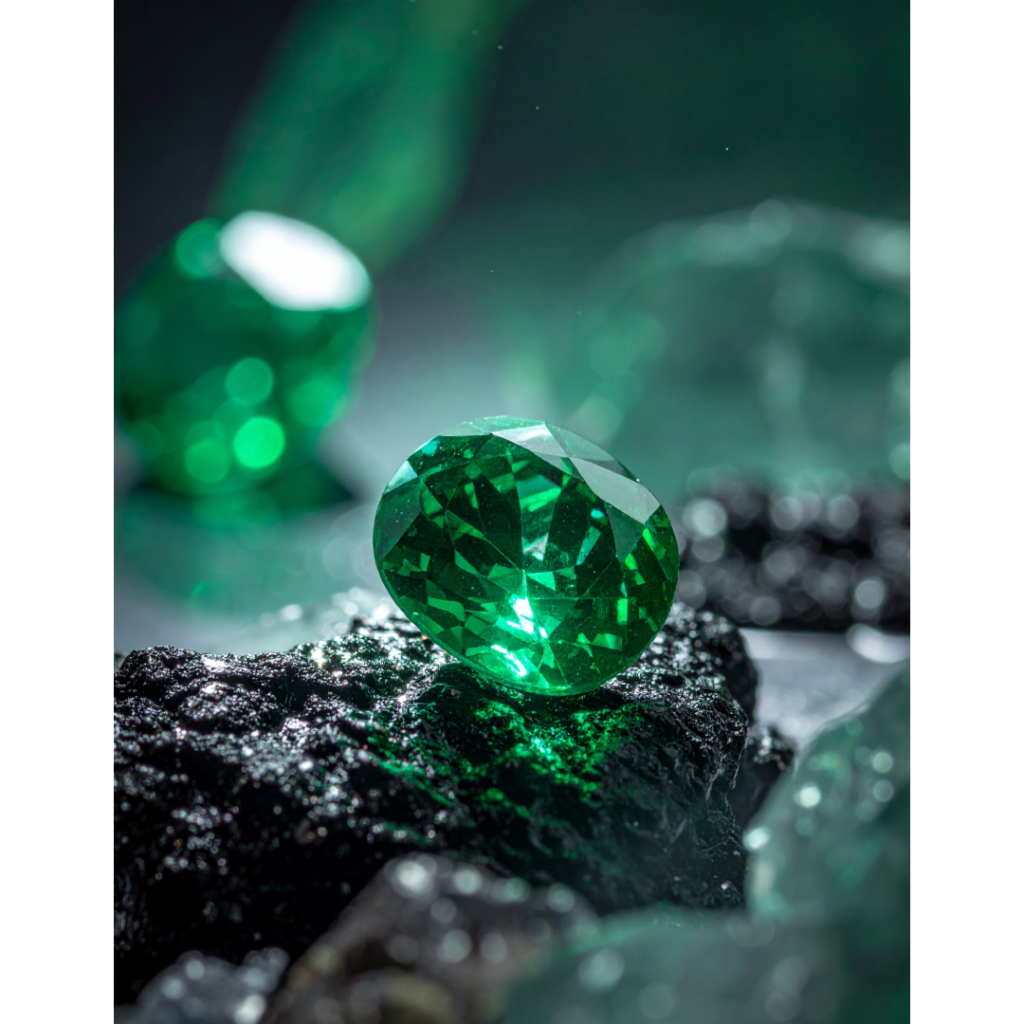
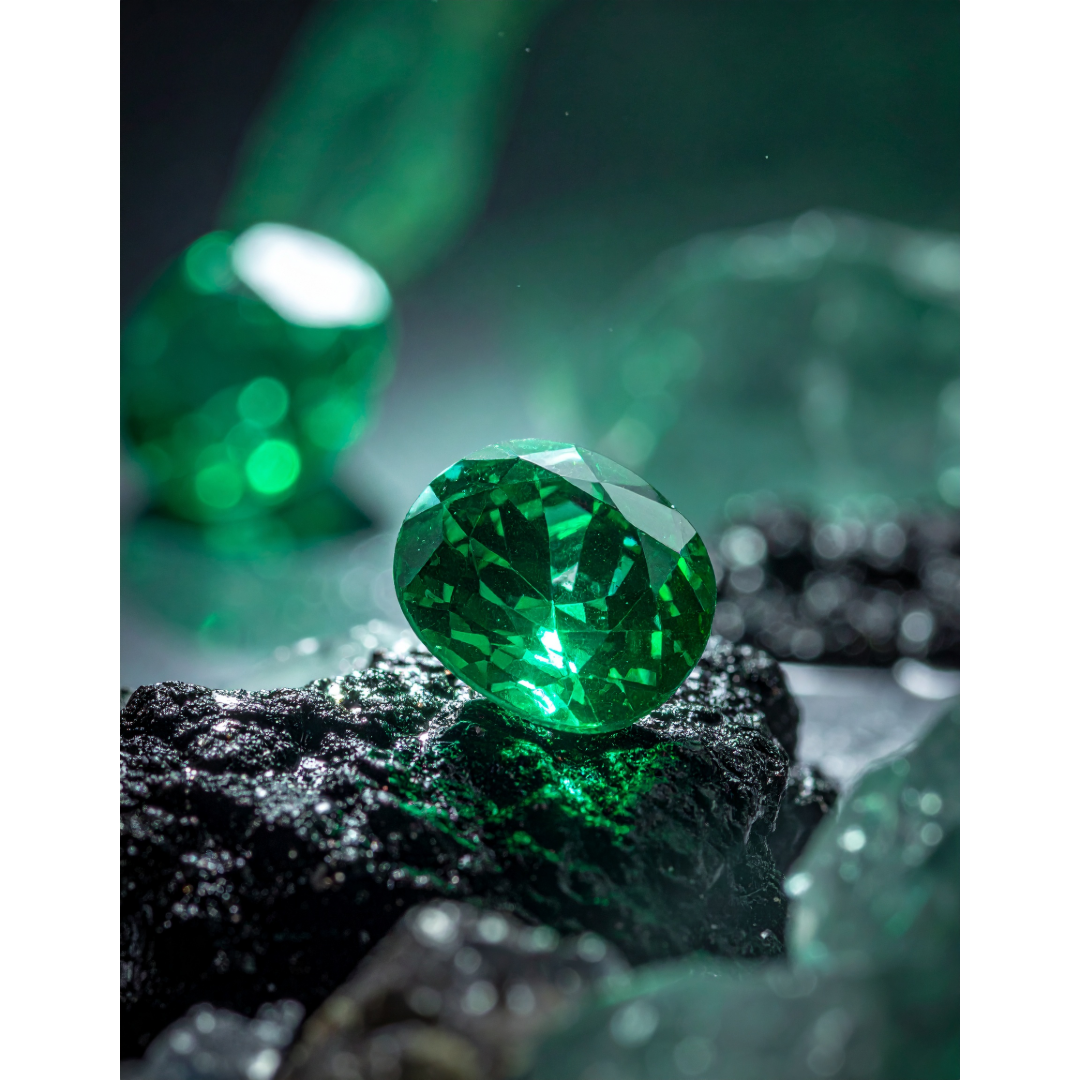
There is a green that cannot be replicated — not by glass, not by tsavorite, not by any laboratory process yet perfected. The emerald carries within it something ancient and irreducible: a depth of colour that seems to hold light rather than merely reflect it, as though the stone itself were illuminated from some interior source.
A History Written in Green
The emerald’s relationship with human desire begins in Egypt, where mines along the Red Sea coast — today known as Cleopatra’s Mines — were worked as far back as 1500 BCE. The Egyptians buried their dead with emeralds as symbols of eternal youth. Cleopatra herself was said to consider them a personal emblem, gifting carved emeralds bearing her own likeness to visiting dignitaries. For a civilisation that built monuments meant to outlast time itself, the emerald was the only stone that felt appropriate.
When Spanish conquistadors arrived in South America in the 16th century, they encountered the Muzo and Chivor mines of present-day Colombia — deposits so abundant and of such quality that they upended the European gem trade entirely. The Mughal emperors of India became among the most voracious collectors, acquiring Colombian emeralds by the shipload and commissioning court jewellers to inscribe them with Quranic verse. Today, these carved Mughal emeralds — some weighing hundreds of carats — are among the most sought after objects at international auction.
What strikes the historian is not simply the scale of emerald devotion, but its consistency across cultures that had no contact with one another. The Incas revered them as sacred. The Romans associated them with Venus. Ancient Indian texts list them among the nine sacred gems of Navaratna. A stone that means the same thing — power, fertility, divinity, renewal — to peoples separated by continents suggests that something in the emerald speaks to a part of the human mind that precedes language.
“The emerald does not ask to be admired. It simply is — and that sufficiency is precisely what four thousand years of devotion has been trying to name.”
What Makes an Emerald an Emerald
Emeralds are a variety of the mineral beryl — the same mineral family that produces aquamarine and morganite — coloured by trace amounts of chromium and, in some cases, vanadium. It is this chromium that produces the characteristic green: a hue that sits somewhere between forest and sea, warm and cool at once, neither settling into yellow nor tipping into blue.
Unlike diamonds, where clarity is near-paramount, emeralds are almost universally included. The gem trade has its own French term for this: jardin — garden — a word that reframes what might otherwise be considered a flaw as something organic and individual. No two emeralds have the same jardin. The inclusions are, in this sense, the stone’s fingerprint: proof that this particular crystal grew in this particular place, under these particular conditions, over millions of years. A loupe-clean emerald should be viewed with some scepticism; it is either extraordinarily rare or has been treated.
The dominant treatment in the emerald trade is oiling — filling surface-reaching fractures with cedar oil or resin to improve apparent clarity. This practice is considered acceptable provided it is disclosed, and emeralds are graded on a scale from None to Heavily Oiled by laboratories such as GRS, Gübelin, and the GIA. At CAROB, we work only with stones that carry minor or no treatment, and every significant piece is accompanied by a laboratory report confirming provenance and treatment status.
The Emerald — Essential Knowledge
- Mineral Family Beryl (Be₃Al₂Si₆O₁₈), coloured by chromium and/or vanadium
- Hardness 7.5–8 on the Mohs scale — durable, but more brittle than sapphire or ruby due to inclusions
- Primary Sources Colombia (Muzo, Chivor, Coscuez), Zambia (Kagem), Zimbabwe (Sandawana), Brazil, Ethiopia, Afghanistan
- Colour Range Bluish-green to yellowish-green; the most valued are pure, vivid green with a slight blue secondary hue — associated with Colombian origin
- Standard Treatment Cedar oil or resin filling (F1–F3 scale); always request a laboratory report confirming treatment degree
- Carat Weight & Value Unlike diamonds, emerald value per carat escalates steeply with size; a fine 5ct Colombian emerald can exceed the per-carat price of a comparable diamond
- Birthstone May; also the traditional gemstone for 20th and 35th wedding anniversaries
- Notable Stones The Bahia Emerald (~180,000 ct rough); the Mogul Mughal Emerald (217.80 ct, inscribed, sold at Christie’s for $2.2 million in 2001)
Colombia, Zambia, and the Question of Origin
Origin matters in emeralds more than in almost any other coloured gemstone. A Colombian emerald — particularly one from the Muzo or Chivor mines — commands a significant premium over a stone of equivalent colour and clarity from elsewhere. The reasons are partly geological, partly historical, and partly a matter of the particular warmth that Colombian chromium produces: a colour that gem dealers describe simply as “the Colombian look.”
Zambian emeralds, primarily from the Kagem mine — the world’s single largest emerald mine by volume — present a compelling alternative. They tend toward a slightly deeper, cooler green, with higher iron content that gives them exceptional transparency. Many gemmologists consider the finest Zambian stones to be undervalued relative to their Colombian counterparts, and the gap has been narrowing as Zambian provenance documentation has improved. For the educated buyer, a Kagem emerald with minor treatment and strong colour is a stone worth serious consideration.
Colombian Emeralds
Muzo and Chivor mines produce the benchmark. Warm, pure green with occasional bluish overtone. Higher chromium, lower iron. The “Colombian look” commands the highest market premiums — often 30–50% above equivalent Zambian stones at the top tier.
Zambian Emeralds
Kagem mine is the world’s largest by volume. Cooler, deeper green; higher iron content produces notable clarity. Increasingly valued by connoisseurs. Strong provenance documentation now available. Excellent value for colour-first buyers.
Zimbabwean (Sandawana)
Small stones of intense, vivid green — some of the most saturated emerald colour on the market. Rarely exceed 1–2 carats. Highly regarded among collectors who understand their rarity; underrecognised by the general market.
Ethiopian Emeralds
A newer source, first reaching commercial quantities in the 2010s. Variable colour and quality, but the best stones show a pure, bright green. Hydrophane material can absorb oils and liquids — an important consideration for care and treatment disclosure.
How to Wear an Emerald Well
The emerald cut — that rectangular step-cut with cropped corners — was not designed for diamonds, as is commonly assumed. It was designed for emeralds, specifically to reduce the mechanical stress on the stone during cutting and to create a broad, open table that allows the colour to read clearly. The large flat facets of the emerald cut are unforgiving of poor clarity, which is precisely why the cut works so well for a stone whose inclusions are part of its character: the jardin is visible, knowable, beautiful.
Set in yellow gold, an emerald takes on a warmth that feels almost classical — the combination that appears in Mughal jewellery, in the parures of European royalty, in the temple jewellery of South India. Set in white gold or platinum, the same stone becomes cooler, more contemporary, the green more electrically vivid. Neither choice is correct. The decision is entirely about the relationship between the stone’s character and the wearer’s intention.
A note on care: emeralds reward gentleness. Avoid ultrasonic cleaners, which can disturb the oil in fractures and make existing inclusions more visible. Warm soapy water and a soft brush is the correct method. Remove emerald jewellery before physical work, gardening, or any activity where the stone might be struck — not because the hardness is low, but because the inclusions that give emeralds their character also give them a brittleness that pure crystals lack. Treat an emerald the way you would a piece of music: with attention, and without carelessness.
“An emerald does not improve with indifference. It asks — in the way that all things worth keeping ask — to be understood.”
The CAROB Perspective
In the Chettiar tradition, jewellery was never decorative in the superficial sense. It was a record — of lineage, of prosperity earned across generations, of aesthetic values refined through centuries of trade along the coasts of South and Southeast Asia. The Nattukotai Chettiars who built CAROB’s legacy moved through spice routes and silk roads, and they encountered emeralds not as novelties but as familiar: stones they had seen in the Mughal courts, in the temple shrines of Sri Lanka, in the trading houses of Burma and Malaya.
When we work with emeralds at CAROB, we work with that history in mind. We are not assembling a product. We are participating in a conversation that began before any of us were alive — a conversation between human beings and a particular green, conducted across four thousand years and four continents, in which the conclusion has always been the same: this stone matters.
We source only stones accompanied by credible laboratory reports. We work with lapidaries who understand that an emerald’s inclusions are not to be disguised but honoured. And we design settings that hold the stone without overwhelming it — because an emerald, properly understood, needs no embellishment. It is, already, complete.
Explore the Collection
Each CAROB emerald is individually selected, and set by hand. If you are looking for a stone with history in it — this is where to begin.
View Emerald Jewellery
Written with care for those who choose with intention.
The Precious You Deserve. — CAROB