The Blue That
Belongs to No One
On a stone that has dressed kings, blessed marriages, and outlasted every civilisation that coveted it.
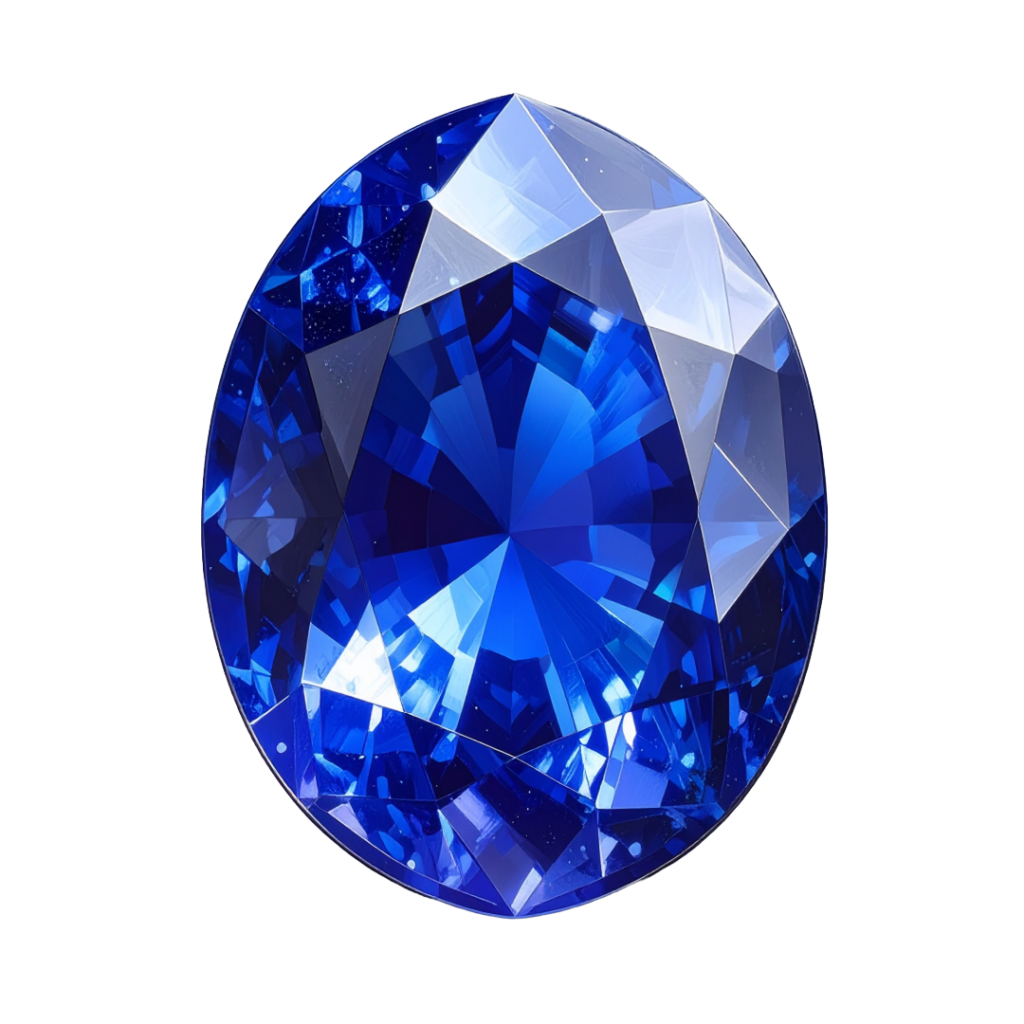
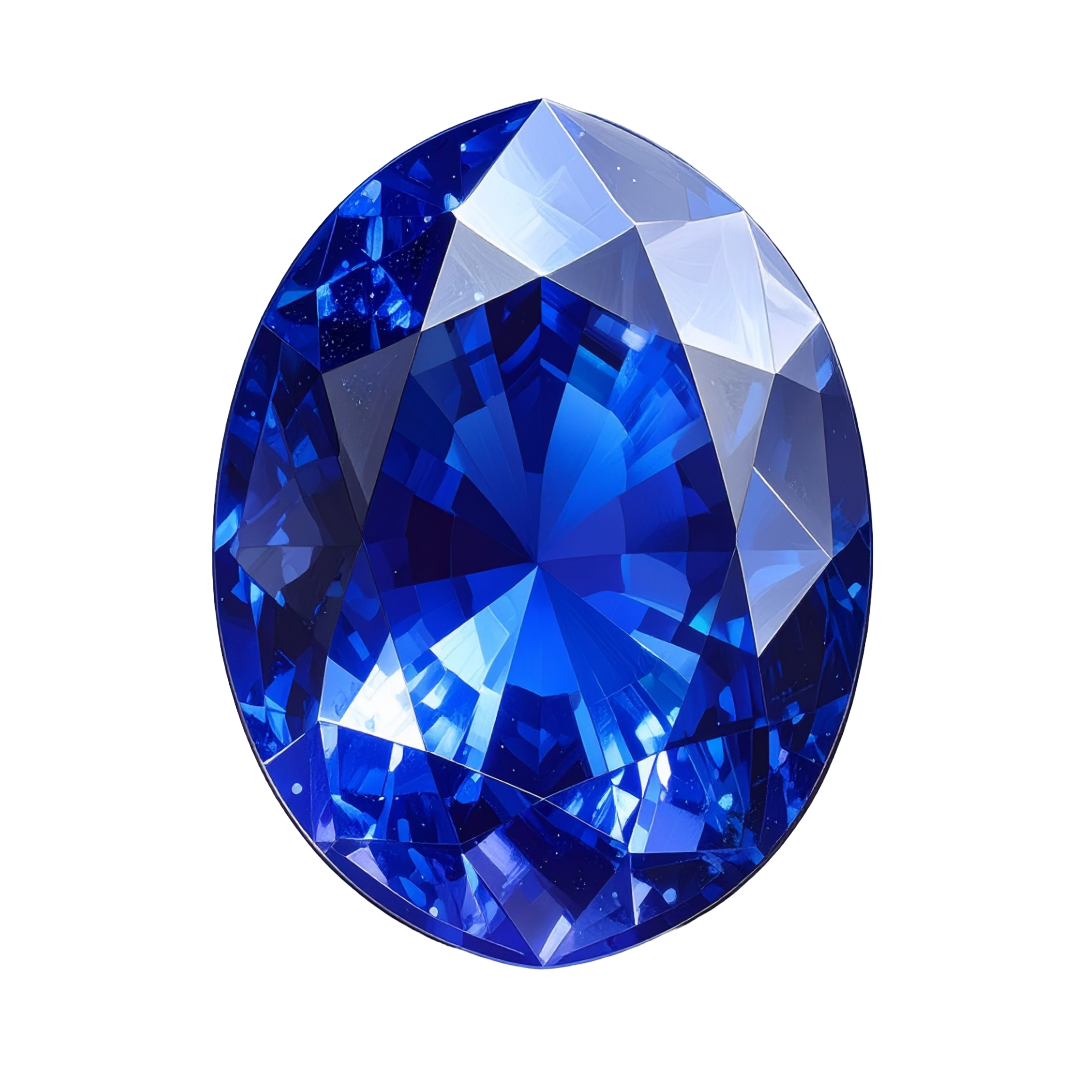
Of all the colours that gemstones offer the human eye, blue is the one that refuses to be possessed. You can hold a sapphire in your palm, set it in gold, wear it against your skin for a lifetime — and still, the blue remains its own. It does not belong to its owner. It belongs, as it always has, to something older and less negotiable than ownership.
A Stone That Preceded Its Own Name
The word sapphire descends from the Greek sappheiros and the Hebrew sappir — both of which, scholars now believe, originally referred not to corundum at all, but to lapis lazuli. The deep blue stone that ancient writers described as the colour of the heavens, flecked with gold like stars, was almost certainly the vivid blue of lapis, mined in Afghanistan and traded westward along routes that predate recorded commerce. Corundum — the mineral we now call sapphire — appears to have inherited the name some centuries later, when it proved to be rarer, harder, and altogether more enduring than the stone it replaced.
That inheritance matters. It means the sapphire entered Western consciousness already freighted with the weight of a prior legend — already understood as a stone of heaven, of wisdom, of divine favour. The medieval Catholic Church made it the stone of bishops and cardinals, reasoning that its celestial colour was fitting for those who mediated between earth and the divine. The British Crown Jewels contain sapphires that have been in continuous royal use for over seven centuries. When Prince Charles presented Lady Diana Spencer with a 12-carat Ceylon sapphire in 1981, it was not a departure from tradition. It was a continuation of one that stretched back to the Middle Ages.
In the Hindu tradition, the sapphire is one of the Navaratna — the nine sacred gems — associated with Saturn and worn to propitiate its influence. In ancient Persia, it was believed that the sky was blue because the earth rested upon an enormous sapphire whose reflection coloured the heavens. Every culture that encountered the sapphire invented a mythology large enough to contain it. This is not coincidence. It is the stone doing what it has always done: demanding an explanation adequate to its presence.
“Every culture that encountered the sapphire invented a mythology large enough to contain it. The stone has always demanded an explanation adequate to its presence.”
Corundum, Colour, and the Chromium Question
Sapphire is a variety of corundum — aluminium oxide in its crystalline form — coloured by trace elements. In the case of blue sapphires, the colour arises from iron and titanium interacting within the crystal lattice, a phenomenon known as intervalence charge transfer. The more precise the balance between these two elements, and the more uniform the distribution through the stone, the more saturated and even the blue.
What makes corundum remarkable as a gem mineral is its promiscuity of colour. The same crystal structure that produces blue sapphire, when coloured by chromium instead of iron and titanium, becomes ruby. When coloured by other combinations of trace elements, it becomes pink sapphire, padparadscha, yellow sapphire, green sapphire, or the phenomenon known as colour-change sapphire — stones that shift between blue and violet or blue and purple depending on the light source. All of these are corundum. All of these are sapphires, by the technical definition. Only the red ones earn the separate designation of ruby — and even that boundary is contested, with pink sapphires and rubies occupying a continuum that no single laboratory draws in precisely the same place.
Corundum is the second hardest mineral on earth after diamond, registering 9 on the Mohs scale. This hardness, combined with a lack of cleavage planes, makes sapphire exceptionally durable — far more so than emerald, and arguably more suitable for everyday wear than any other coloured gemstone. A well-set sapphire, worn with reasonable care, will outlast its owner by centuries. The sapphires in medieval regalia still look, under magnification, much as they did when they were first cut.
The Sapphire — Essential Knowledge
- Mineral Species Corundum (Al₂O₃), coloured by iron and titanium (blue); chromium produces pink to red (ruby)
- Hardness 9 on the Mohs scale — second only to diamond; no cleavage, highly resistant to chipping
- Primary Sources Kashmir (India), Ceylon / Sri Lanka, Burma (Myanmar), Madagascar, Australia, Montana (USA), Tanzania
- Colour Range All colours except red; blue is most prized. Finest blue: vivid, pure, medium-dark — neither too light nor inky. Padparadscha (pink-orange) is among the rarest and most valuable varieties
- The Kashmir Standard Kashmir sapphires, mined in the Zanskar Range at altitude between 1879 and the early 20th century, set the benchmark for blue. Their characteristic velvety quality — caused by minute silk inclusions — has never been replicated by any other deposit
- Standard Treatments Heat treatment (accepted and standard; improves colour and clarity); beryllium diffusion (must be disclosed; controversial); fracture filling (rare; always disclose)
- Birthstone September; also the traditional gemstone for 45th and 65th wedding anniversaries
- Notable Stones The Star of India (563 ct, American Museum of Natural History); the Blue Belle of Asia (392.52 ct Ceylon sapphire, sold at Christie’s Geneva 2014 for $17.3 million)
Kashmir, Ceylon, Burma — The Geography of Blue
No discussion of sapphire is complete without an account of Kashmir — not because Kashmir sapphires dominate today’s market (the mines were largely exhausted by the early 20th century and production has been negligible for decades), but because they established the standard against which every other sapphire is still measured. Found at elevations above 4,500 metres in the Zanskar Range, Kashmir sapphires possess a quality that gem dealers have struggled for over a century to describe precisely: a velvety quality, a softness in the blue, as though the colour were lit from within rather than reflected off facets. This effect is caused by clouds of minute rutile silk inclusions that scatter light within the stone, reducing brilliance but producing something more difficult to name — a meditative depth that photographs consistently fail to capture.
Ceylon sapphires — from the island now known as Sri Lanka — represent the most commercially significant source of fine blue sapphires in the world. The gem gravels of Ratnapura and Elahera have been worked for over two thousand years, producing an extraordinary range of blues: from the pale, limpid “cornflower” blue that many buyers associate with the Ceylon origin, to deeper, richer stones that approach Burmese intensity. Sri Lankan sapphires are also the primary source of padparadscha — the rare pink-orange variety whose name derives from the Sinhalese word for lotus blossom — and of the finest colour-change stones.
Burmese sapphires, from the Mogok Valley, tend toward a deeper, more saturated blue than Ceylon stones, with a character that some describe as royal rather than celestial. Madagascar has emerged in recent decades as a major source, producing stones across the full colour spectrum; the finest Madagascan blues are now regularly mistaken for Ceylon origin even by experienced dealers.
Kashmir
The unreachable benchmark. Velvety, internally lit blue caused by silk inclusions. Production effectively ceased by the 1930s. A certified Kashmir origin adds 30–50% or more to value. Increasingly rare at auction; when available, commands the highest per-carat prices of any blue sapphire.
Ceylon (Sri Lanka)
The world’s most important source for over two millennia. Wide colour range from pale cornflower to deep royal blue. Also produces padparadscha and colour-change. Consistent quality, reliable provenance documentation. The benchmark for accessibility at the fine end of the market.
Burma (Myanmar)
Mogok Valley produces deep, saturated blues with a warm, slightly violet character. Considered second only to Kashmir among connoisseurs. Burmese origin adds a meaningful premium. Ethical sourcing documentation is essential given political context; always verify chain of custody.
Madagascar
The dominant commercial source since the late 1990s. Produces the full colour spectrum; finest blues are now considered genuinely comparable to Ceylon. Strong value proposition for colour-first buyers. Increasingly well-documented provenance as the market matures.
Heat, Honesty, and What a Certificate Tells You
The vast majority of sapphires on the market — well over 90 percent, by most industry estimates — have been heat-treated. Heating corundum at high temperatures dissolves silk inclusions, improves colour saturation, and removes unwanted colour zoning. The practice is centuries old, widely accepted, and considered standard in the trade provided it is disclosed. A heated sapphire of fine colour and clarity is not a lesser stone; it is simply a stone that has been optimised by a process that nature began and a craftsman completed.
What matters — and what separates a trustworthy purchase from an uninformed one — is disclosure. An unheated sapphire of fine colour commands a substantial premium — sometimes double the price of an equivalent heated stone — because the colour is entirely natural, unassisted, and therefore rarer. At the top of the market, unheated Ceylon and Kashmir sapphires with strong colour are among the most valuable coloured gemstones in existence.
“A sapphire does not need to be unheated to be fine. It needs to be honest — and the difference between those two things is where most of the market’s confusion lives.”
How to Wear a Sapphire
The sapphire’s hardness makes it one of the few coloured gemstones genuinely suited to daily wear — in rings especially, where stones face the most mechanical stress. Unlike emerald, it does not require the special handling of a fragile piece. Unlike pearl or opal, it is indifferent to water, perfume, and the ordinary abrasions of a lived life. This is not an invitation to carelessness; it is simply an acknowledgement that the sapphire was built, at the molecular level, for endurance.
In terms of setting, blue sapphires have a particular affinity with platinum and white gold — the cool metal amplifies the blue without competing with it. Yellow gold, by contrast, creates a contrast that some find striking and others find discordant; the warmth of the gold pulls the blue toward green, subtly altering the stone’s apparent colour. Rose gold occupies an interesting middle position, its warmth softened enough to complement rather than challenge a mid-blue stone.
The oval cut remains the most popular for sapphires, partly because it maximises the colour depth visible through the table, and partly because it presents well in the engagement ring context where sapphires have long been prominent. The cushion cut — the modern descendant of the old mine cut — tends to produce a softer, more romantic light return, and suits the velvety quality of the finest Ceylon and Kashmir stones particularly well. A well-proportioned sapphire, regardless of cut, should show even colour across the face of the stone with no obvious windowing — areas where the stone appears pale or washed out due to shallow pavilion depth.
The CAROB Perspective
The Chettiar merchants who form CAROB’s lineage traded along the coasts of Ceylon for generations. Colombo and Galle were not distant destinations; they were nodes in a network of commerce and kinship that connected Tamil Nadu to Burma, to Malaya, to the trading posts of the Straits. Sapphires from the gem gravels of Ratnapura would have passed through Chettiar hands — assessed, valued, and moved onward — as a matter of ordinary business. The gem was familiar before it was precious; known before it was coveted.
This history informs how we approach sapphires at CAROB. We do not approach them as objects of desire to be packaged and sold. We approach them as things we have always known — stones with a specific gravity and a specific provenance and a specific place in a tradition of adornment that has been practised, with care and with knowledge, for longer than most institutions have existed.
When we select a sapphire for a CAROB piece, we are selecting for the quality of the blue — its depth, its evenness, its character under different lights — but we are also selecting for something less easily quantified: the sense that this stone has arrived at the right place. That it will be worn by someone who understands what they are wearing. That the centuries of craft and commerce that brought it from a river gravel in Ceylon or a mountain mine in Kashmir to a workshop in South India will be, in some small way, honoured by the wearing of it. This is what we mean when we say the precious you deserve.
Explore the Collection
Each CAROB sapphire is chosen for the quality of its blue and set by hand in our workshop. If you are looking for a stone built to last generations — begin here.
View Sapphire Jewellery
Written with care for those who choose with intention.
The Precious You Deserve. — CAROB